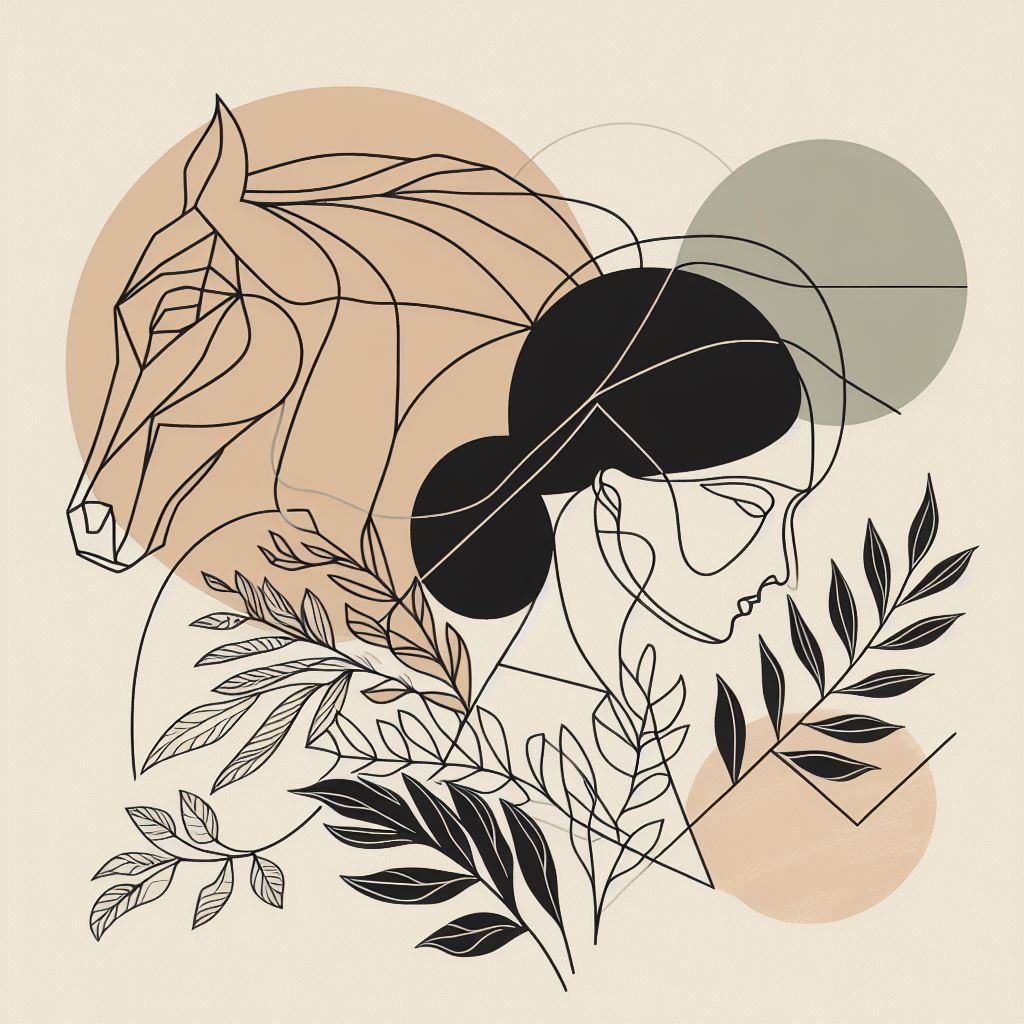
What is one word that describes you?
Horse-sense. Technically two words, or a double barrelled compound word? Anyhow it’s the first that came to mind.
“My favorite animal is the mule. He has more horse-sense than a horse. He knows when to stop eating – and he knows when to stop working.“
Harry S Truman
Horse-sense, also known as common sense, refers to practical knowledge and good judgment about ordinary life. It’s a robust form of reasoning believed to be found in poorly educated but shrewd individuals. The term “horse-sense” likely originated in the wild west, associated with plain-talking folks who relied on practical wisdom rather than high-falutin’ claptrap. So, when someone exhibits horse-sense, they’re demonstrating down-to-earth, no-nonsense thinking—akin to a cowboy in a wide-brimmed hat sizing up a situation and making sensible decisions.

Horse-sense and Humility

In the quiet of the stable, where hooves meet straw, Horse-sense whispers secrets, ancient and raw. Not the wisdom of scholars or ivory towers, But the knowing that blooms in moonlit hours.

I. Horse-Sense

Hooves on earth, a rhythm unbroken, The steed, unlettered, yet words unspoken. He senses the storm before clouds unfurl, Navigating life’s trails with instinctual swirl.

“Watch the wind,” he seems to say, As he grazes on grass at the break of day. His eyes, deep pools of weathered lore, Hold tales of sunrises and battles of yore.

Horse-sense—a compass forged in the wild, Guiding us through deserts, forests, and mild. No fancy theories or grand dissertations, Just the pulse of survival, ancient foundations.

II. Humility

Now step into the meadow, where dew-kissed grass, Bows to the morning sun, a gentle pass. Here, humility blooms like wildflowers unseen, Its fragrance subtle, yet its roots run deep and keen.

“I am but a blade of grass,” whispers the bloom, As it bends under raindrops, casting off gloom. Not the tallest, nor the showiest in the field, Yet it yields to the wind, its purpose revealed.

Humility wears no crown, seeks no applause, It’s the quiet stream that carves through stone and flaws. Not the thunderous waterfall, but the patient flow, Eroding pride’s cliffs, revealing what we know.

III. The Dance

And so, in the dance of horse-sense and humility, We find balance—the art of living with nobility. For the horse knows the trail, the grass bows low, And together they teach us how wisdom can grow.

“Be shrewd as the steed,” says the whispering breeze, “Yet tender as petals, rooted in ease.” For in the union of earth and sky, we find grace, Where horse-sense and humility intertwine, embrace.

So let us ride with purpose, our hearts unbridled, And walk with heads bowed, our egos sidled. For wisdom lies not in grand proclamations, But in the quiet knowing of life’s revelations.

May horse-sense guide our steps, and humility be our compass. 🌟🐎🌿
Horse-Sense
Horse-sense is a robust form of common sense believed to be found in poorly educated but shrewd individuals. The term might seem peculiar at first, considering that horses wouldn’t typically be associated with mental discernment. However, let’s explore its origin and meaning.
Origin:
In medieval England, where present-day English was largely formed, horses played a significant role in people’s lives. Interestingly, rural language often formed around the hefty, coarse, or even vulgar nature of working horses. For instance:
• Horse-daisy: A country name for the Ox-eye Daisy.
• Horse-radish: A large root resembling a radish but with a fiery taste.
• Horse-gentian: Also known as Feverwort.
• Horse-nettle: Referring to Nightshade.
• Horse-parsley: An outsize parsley-like plant tasting of celery.
Adding the prefix “horse” rendered any item somewhat comic. For instance, a watchman’s ratchet or rattle became a “horse-fiddle”, and a form of deck quoits using a large wooden disc turned into “horse-billiards”.
However, horse-sense deviates from this pattern. It conveys an unsophisticated, country type of sense—common sense that contrasts with the high-falutin’ claptrap of what we might now call “men in suits.” While equine violins or billiards tables are ludicrous, “country-sense” holds value.
Usage:
The expression horse-sense often conjures images of plain-talking folks in cowboy hats, particularly in the wild west. American writer James Kirke Paulding, in his novel Westward Ho! (1832), described a character as having “good strong horse sense.” The phrase likely originated in the West and was applied to those who exceeded others in practical wisdom.
So, next time you encounter someone with practical, down-to-earth wisdom, you might just appreciate their horse-sense!
Humility
Humility is a virtue that transcends cultural boundaries. It involves recognizing our limitations, acknowledging the contributions of others, and maintaining an open mind. Here are some key aspects of humility:
• Self-Awareness: Humble individuals have a realistic view of their abilities and shortcomings. They don’t overestimate their importance or expertise.
• Openness to Learning: Humility allows us to learn from others, even those we might consider less experienced. It’s the willingness to say, “I don’t know, but I’m eager to learn.”
• Empathy: Humble people listen actively and empathize with others. They recognize that everyone has their struggles and challenges.
• Gratitude: Humility involves appreciating the contributions of others and expressing gratitude. It’s not about self-promotion but about recognizing collective efforts.
• Servant Leadership: Humble leaders prioritize the well-being of their team and focus on serving rather than dominating.
In essence, humility is not weakness; it’s strength tempered by wisdom. It allows us to grow, connect, and contribute positively to the world.
⁰Remember, both horse-sense and humility have their unique places in our understanding of life and human nature.
Horse-sense is not about actual horses playing violins or billiards; it’s about good old-fashioned practicality! 🤠🐎
 Gipsi Art Blog